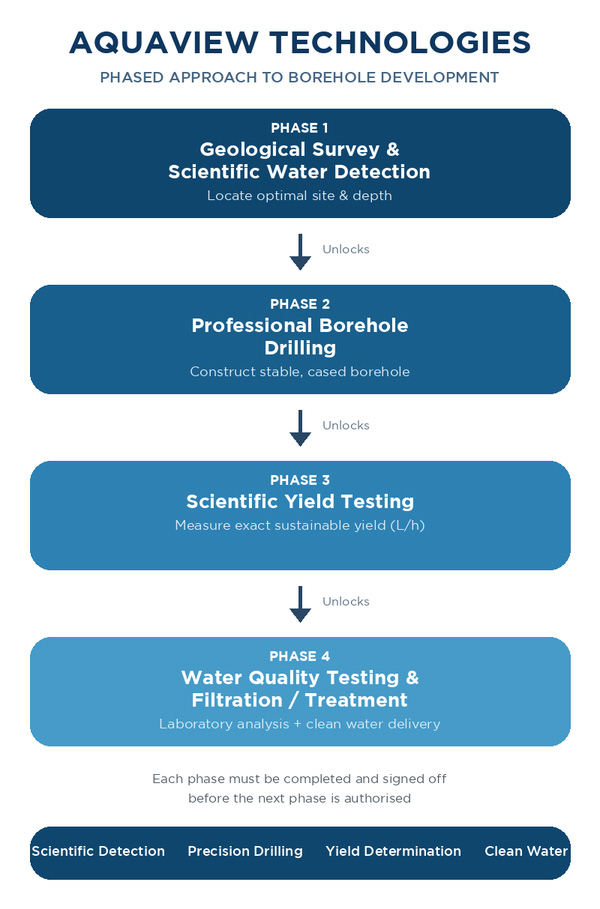
PHASED APPROACH TO BOREHOLE DEVELOPMENT
Introduction
Aquaview Technologies’ gated, evidence-based methodology for the development of private borehole water systems in Gauteng, South Africa. Each phase must be completed and formally signed off before the subsequent phase is authorised. This sequential structure is designed to minimise financial risk, eliminate guesswork, support regulatory alignment where applicable, and deliver a fully functional, safe and sustainable water solution.
Aquaview Technologies operates as a single accountable turnkey specialist. We manage the complete value chain — scientific groundwater detection, professional drilling, scientific yield determination, laboratory water-quality analysis, custom filtration design, pump and reticulation installation, system commissioning and ongoing support – under one coordinated team.
Progression from one phase to the next is contingent on successful completion and formal acceptance of the preceding phase.
Phase 1 - Geological Survey & Scientific Water Detection
Objective
Identify the shallowest, most productive and sustainable drilling target on the property before any drilling capital is expended.
Why This Phase Is Critical
Geological conditions can change dramatically over short distances. Drilling contractors charge per metre drilled regardless of whether water is found. A dry or low-yielding hole represents a pure financial loss. The deeper the borehole, the more expensive the drilling process becomes. Aquaview’s geological survey determines the exact drill-site location and the required depth, deliberately selecting the most cost-effective, shallowest and most sustainable drilling position available on each property. The survey is typically priced at approximately 5% of total drilling cost and reduces the risk of a dry or uneconomic hole by an estimated 97–99%.
Methodology (Aquaview Technologies Process)
1. Satellite Imagery & Field Map Study
High-resolution satellite imagery is combined with topographic and gradient analysis to determine the direction of underground water flow relative to land surface. This identifies the most promising cross-section of the rock formation for detailed investigation.
2. Pre-survey Desktop Study
- Regional geological maps and available hydrogeological data are reviewed.
- Records of existing boreholes on neighbouring properties (location, depth of water strikes, reported yields) are collected and analysed.
- Topography, drainage patterns and known structural features (dykes, lineaments, fractures) are evaluated.
3. On-site Geophysical Survey
Advanced electromagnetic technology is deployed. The equipment transmits electromagnetic pulses and measures differences in electromagnetic field frequencies, electrical properties, rock density, cavities and groundwater response. The output is a geological curve graph (cross-section) that shows:
- Layers of differing rock density
- Location and depth of water-bearing fractures, cavities or aquifers
- Estimated depth of the primary water vein
Technology is combined with traditional water-divining techniques to optimise the final recommended drilling point.
Deliverables
- Visual underground water imagery and geological cross-section report
- Precise recommended drilling co-ordinates and target depth
- Clear written drilling strategy provided to both the client and the drilling team
Unlock Criterion
Phase 2 (Drilling) is authorised only after a viable, data-supported target has been identified and accepted by the client.
Phase 2 - Professional Borehole Drilling
Objective
Construct a stable, properly cased borehole exactly at the location and to the depth determined in Phase 1.
Key Principles
- Drilling is performed only after Phase 1 has supplied a clear target.
- Modern rotary or appropriate drilling rigs are mobilised with a data-driven strategy.
- Unnecessary metres are avoided, controlling cost.
- Appropriate casing is installed to protect borehole integrity, prevent surface contamination and safeguard long-term water quality.
- All work is executed by Aquaview’s experienced crews who retain full responsibility for safety, quality and successful completion.
Pricing Structure
Drilling is normally charged per metre drilled. As a general rule, the deeper the borehole, the higher the total cost. This industry-standard approach ensures transparency and allows clients to budget according to the target depth established in Phase 1. Because the geological survey identifies the shallowest viable and most sustainable drill site on the property, clients benefit from the lowest practical drilling cost while still securing a reliable long-term water source. From time to time Aquaview Technologies also runs limited drilling specials or promotional packages; clients are advised of any current specials at the quotation stage.
Outcome
A completed, stabilised borehole ready for yield testing.
Unlock Criterion
Successful installation of casing and confirmation that the borehole is structurally sound unlocks Phase 3.
Phase 3 - Scientific Yield Testing
Fundamental Principle
There is currently no science or technology available globally that can accurately predict the exact volume of water a borehole will produce before it is drilled and tested. Geophysical methods (Phase 1) locate water-bearing structures and estimate depth with high reliability, but actual sustainable yield can only be measured after the borehole has been constructed.
Typical Context in Greater Gauteng
- Average borehole yields commonly fall in the range of 1 200 – 1 500 litres per hour.
- For planning purposes, average South African domestic utilisation is referenced at approximately 230 – 250 litres per hour (household-level comparative figure).
Aquaview Yield-Testing Protocol
1. Immediate On-site Manual Flow-Rate Check
Performed as soon as drilling is complete to provide an initial indication of productivity.
2. Formal Controlled Yield Test
- Residential applications: typically 4-hour controlled test.
- Commercial / higher-demand applications: 24-hour (or longer) controlled test.
3. Scientific Methodology
Specialised pumping equipment is used to draw the water level down in a controlled manner. Scientific data loggers continuously record:
- Flow rate (litres per hour)
- Drawdown (decline in water level)
- Recovery rate once pumping ceases
The recovery data is particularly important: it quantifies how quickly the surrounding aquifer recharges the borehole and forms the basis for calculating a sustainable long-term yield.
Alignment with South African Practice
Where formal certification or higher-level analysis is required, testing can be extended to incorporate elements of SANS 10299-4:2003 (step-drawdown followed by constant-discharge testing and recovery monitoring). For most residential applications the 4-hour protocol provides practical, usable data for pump sizing.
Outcome
A documented, exact sustainable yield figure (litres per hour) that finalises the success of the drilling programme and provides the essential design parameter for all subsequent equipment and treatment sizing.
Unlock Criterion
A completed yield test confirming a viable sustainable yield unlocks Phase 4.
Phase 4 - Water Quality Testing & Filtration / Treatment
Objective
Transform the raw borehole water into clean, safe, aesthetically acceptable water that is correctly matched to the client’s intended use (domestic drinking, household general use, irrigation, commercial or industrial) and to the sustainable yield established in Phase 3.
Step 1 – Laboratory Water Quality Analysis
A representative water sample is submitted for full laboratory analysis covering chemical, physical and bacteriological parameters. Typical parameters examined include (but are not limited to):
- Iron and manganese
- Hardness (calcium and magnesium)
- Turbidity and sediment
- pH and total dissolved solids (TDS)
- Nitrates
- Microbial indicators (E. coli, coliforms)
- Other regionally relevant constituents
Results are evaluated against SANS 241 drinking-water guidelines where potable use is intended.
Common Gauteng Borehole Water Challenges
- Elevated iron and manganese (staining, metallic taste, pipe clogging)
- Hard water (scale formation in geysers, kettles and plumbing)
- Sediment / sand (especially in certain formations)
- Occasional bacteriological contamination (particularly after heavy rainfall or where surface sealing is imperfect)
- Variable turbidity
Step 2 – Custom Filtration & Treatment System Design
Using both the laboratory results and the exact sustainable yield from Phase 3, Aquaview designs a multi-stage treatment train sized for the client’s peak and average demand. Typical components may include:
- Sediment / pre-filtration
- Iron and manganese removal (catalytic media, aeration or specialised filters)
- Water softening (where hardness is excessive)
- Disinfection (UV sterilisation is widely preferred for its chemical-free effectiveness against bacteria and viruses)
- Optional reverse-osmosis or specialised processes for nitrates or elevated TDS where required
The system is engineered so that it does not exceed the sustainable yield of the borehole and includes appropriate storage and pressure management.
Step 3 – Supply, Installation & Commissioning
- Equipment is supplied and installed by Aquaview technicians.
- The complete system is commissioned, performance-verified and handed over with operating instructions.
- Clean, treated water is delivered ready for connection into the property’s plumbing or distribution network.
Unlock / Completion Criterion
Successful laboratory analysis, system design, installation and commissioning complete the turnkey solution. The client receives a fully functional, treated borehole water system supported by documentation of yield and water quality.
Summary of the Gated Process
|
Phase |
Title |
Core Purpose |
Primary Deliverable |
Unlocks |
|
1 |
Geological Survey & Water Detection |
Scientifically locate optimal site & depth |
Visual report + drilling strategy |
Phase 2 |
|
2 |
Professional Drilling |
Construct stable, cased borehole at proven target |
Completed borehole |
Phase 3 |
|
3 |
Scientific Yield Testing |
Measure exact sustainable litres per hour |
Documented yield report |
Phase 4 |
|
4 |
Water Quality + Filtration & Treatment |
Laboratory analysis + designed treatment system matched to yield |
Clean, safe, treated water on demand |
Complete |
Additional Value-Added Services
The following services are available after Phase 4 to complete a full end-to-end water solution:
- High-efficiency submersible pump installation (grid or solar options)
- Storage tanks, pressure controllers and full reticulation
- System commissioning, client training and handover documentation
- Preventative maintenance plans and borehole rehabilitation services